

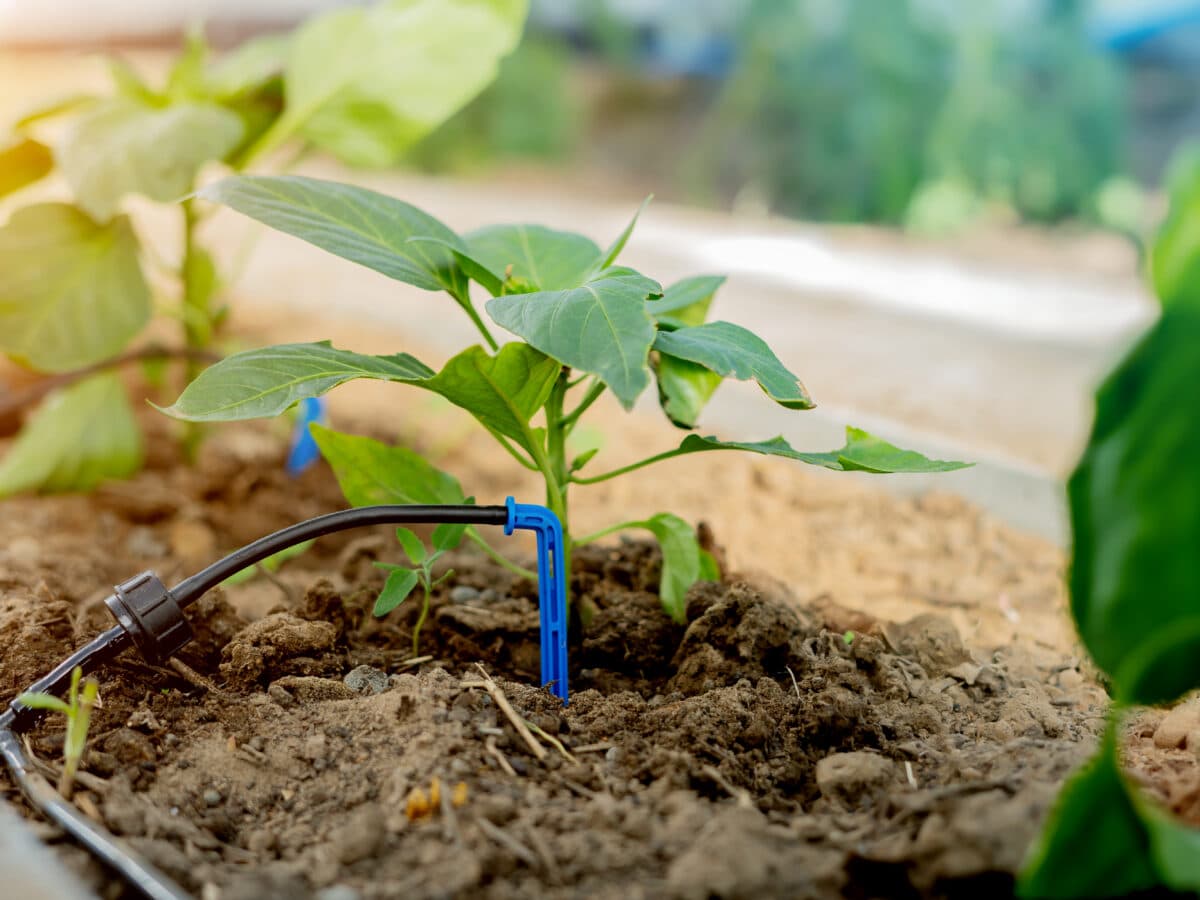
Every drip irrigation question eventually becomes this one. Run it too little and roots stay shallow; too much and you’re watering the water table while roots suffocate. The charts below give you solid starting points, and the ten-minute dig test at the end makes them exact for your garden.
The three variables
Run time depends on three things, in this order of importance:
- Soil type. Sand drains in hours, clay holds for days. Same plant, totally different schedule.
- What’s planted. Shallow lettuce roots versus a tomato’s two-foot root system.
- Season and weather. August wants up to double what May wants.
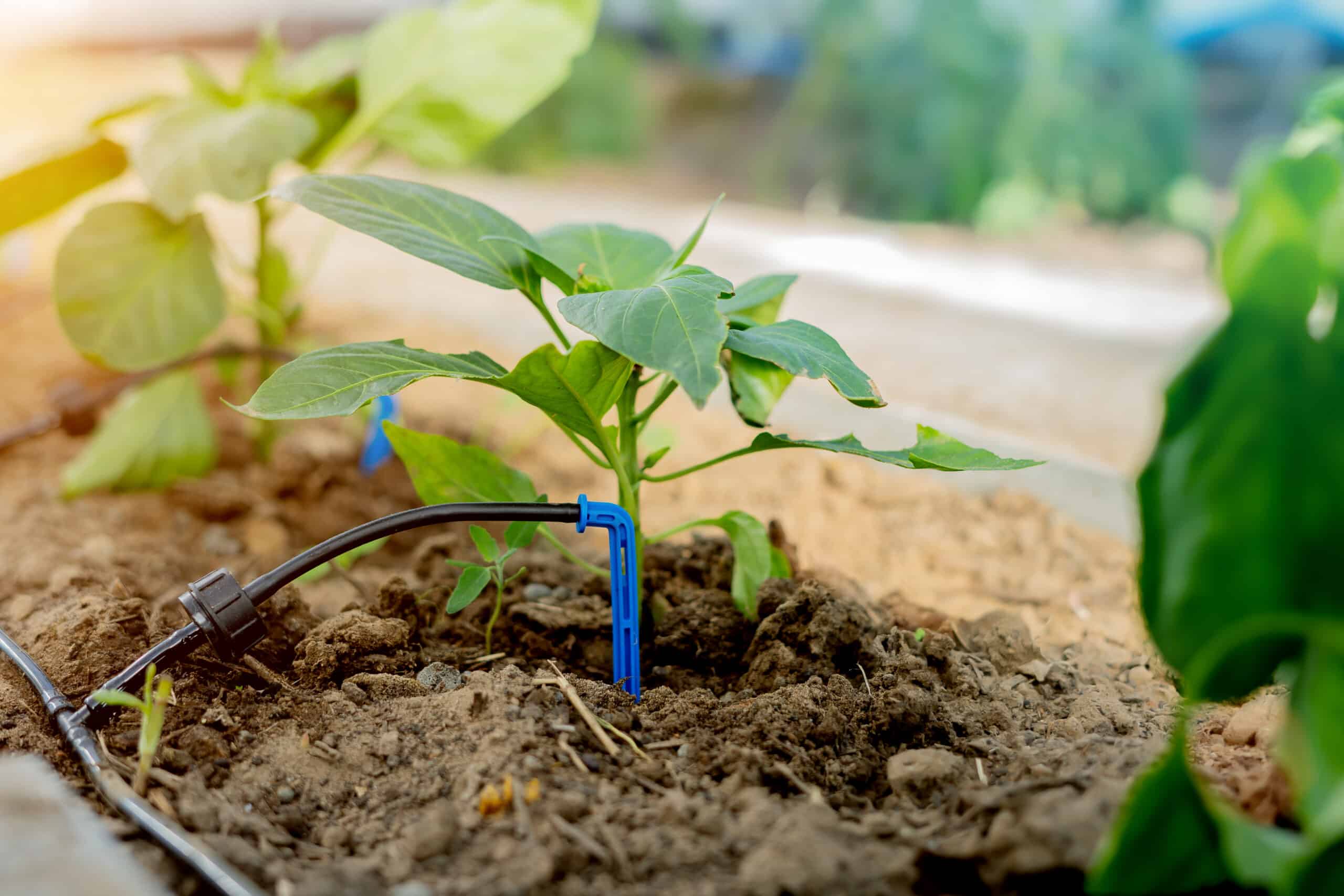
Emitter flow rate matters too, but the math is easy: a 1 GPH emitter delivers exactly one gallon per hour. Run 45 minutes, the plant got three-quarters of a gallon. No mystery.
Starting-point run times
Assuming 1 GPH emitters (or 0.5 GPH dripline at 12-inch spacing) on loam soil:
| Planting | Run time | Frequency |
|---|---|---|
| Vegetables (dripline beds) | 45-60 min | Every 1-2 days |
| Raised beds | 45-60 min | Every 1-2 days |
| Annual flowers | 30-45 min | Every 2 days |
| Established shrubs/perennials | 60-90 min | Every 3-4 days |
| New trees (year 1) | 90-120 min | Twice a week |
| Containers | 15-30 min | Daily in summer |
| Lawns (subsurface drip) | 30-45 min | Every 2-3 days |
Now adjust for soil:
- Sandy soil: cut run times by about a third, water more often. Sand holds little, so little and often wins.
- Clay soil: run longer, much less often. Clay absorbs slowly and holds deep, so one long soak a week can be right for shrubs.
Adjusting through the year
A program set in April is wrong by July. Rough seasonal multipliers for temperate climates:
- Spring: baseline, or even half during cool wet weeks
- Summer peak: baseline plus 25 to 50 percent; containers may need daily
- Fall: taper back to baseline, then half
- Winter: off in cold climates (see winterizing your drip irrigation system), minimal in mild ones
And always skip after real rain. Half an inch of rain replaces a full session for most beds.
The dig test: ten minutes, exact answer
Charts get you close; this makes you right. Do it once per zone, a week after setting your schedule:
- Run a normal session.
- Wait one hour (water needs time to spread and settle).
- Dig a hole 4 to 6 inches deep near an emitter, at the canopy edge, not the stem.
- Feel the soil. The target: moist like a wrung-out sponge at the full depth. Cool, dark, holds together when squeezed, no water dripping out.
Read the result:
- Dry below 2 inches: increase run time 50 percent and retest.
- Moist exactly right: done. Write the schedule on the timer box.
- Mud, or water squeezes out: cut the run time a third. Soggy soil starves roots of oxygen.
Repeat after big weather changes, and once mid-summer. After a season you’ll set it by feel.
Signs the schedule is wrong
- Wilting at midday that recovers by evening: normal heat response, not thirst. Check soil before changing anything.
- Wilting at sunrise: genuinely dry. Water now, then increase run time.
- Yellow lower leaves, soft stems, fungus gnats: overwatering. Cut back.
- Algae or green crust on the soil surface: sessions too frequent, surface never dries. Longer and rarer.
- Tomatoes splitting or blossom end rot: inconsistent moisture. Same total water, delivered on a steady rhythm. The fix is the timer, not the fertilizer; programming help is in timer for drip irrigation.
Plant-specific deep dives
Some plants earn their own schedule. We’ve written them up individually: hydrangeas, trees, arborvitae, and raised beds.
FAQ
Is it better to run drip irrigation long and rarely, or short and often?
Long and rarely, for almost everything. Deep sessions push roots downward and leave the surface dry, which discourages weeds and fungus. Short daily sessions are only right for containers and brand-new seedlings.
How many gallons does a vegetable garden need per week?
The classic extension answer is 1 to 1.5 inches of water per week including rain, which works out to roughly 60 to 90 gallons per 100 square feet. Your emitter count times GPH times hours tells you exactly what you’re delivering.
Should I water at night instead of morning?
Morning wins. Night watering leaves foliage and surface soil damp for hours, which slugs and fungi treat as an invitation. Early morning gives the same evaporation savings without the overnight damp.
My system runs on a well with low flow. Does that change run times?
No: run times are about how much water plants need, and that’s unchanged. What changes is zone size, since a weak well feeds fewer emitters at once. More zones, same minutes.
Set the chart values, verify with the dig test, and adjust by season. That’s the entire discipline. More schedule guides live in Watering Schedules.
1 comment
Comments are closed.