

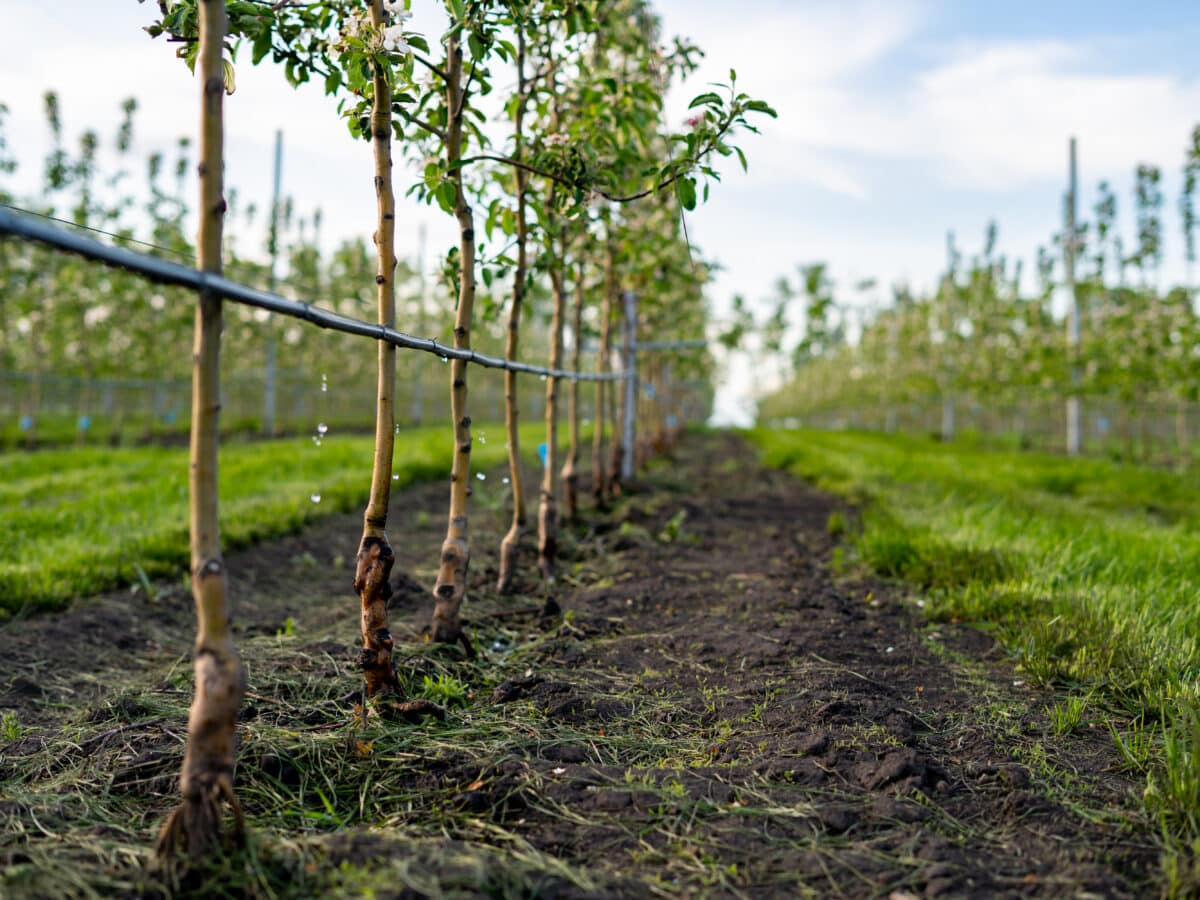
Trees get watered worse than almost anything else in a yard, usually because the advice people find is written for shrubs or lawns instead. Run a tree on a shrub schedule and a young maple ends up chronically underfed. Run it on a lawn schedule and the grass roots get wet while the tree’s real feeder roots, a foot down and well past the trunk, barely notice. Here’s how long to actually run drip irrigation for trees, by age, size, and season, plus the one adjustment that matters more than any number on the timer.
The short answer
For an established yard tree on 2 GPH emitters and average garden soil, plan on 60 to 120 minutes per session, once or twice a week during the growing season, tapering to once every 2 to 4 weeks for mature trees in a dry summer. Newly planted trees want shorter, more frequent sessions instead. That’s a starting point to verify with a soil check, not a number to set and walk away from, since trunk diameter and emitter count move the real answer more than the minutes on the dial.
Why trees don’t follow the shrub or lawn playbook
The absorbing roots on a tree, the ones actually pulling in water, sit mostly in the top 12 to 24 inches of soil and spread out well past the edge of the canopy, often one and a half to two times the branch spread. That’s wide and shallow, not deep. Aim a single emitter at the trunk and run it for hours, and the water mostly disappears straight down in a narrow column that the tree’s real root zone never touches.
This is the trap specific to trees: because they’re big, the instinct is to water for a long time in one spot. What a tree actually needs is water spread across a wide ring at or near the drip line, the point on the ground below the outer edge of the canopy, so the same total gallons reach far more of the root system instead of punching one deep hole next to the trunk.
Run times by tree type, size, and age
These assume 2 GPH emitters on loam soil, with emitter count and ring size scaled to trunk diameter and canopy spread. Sandy soil: shorten sessions by about a third and water more often. Clay soil: stretch the interval between sessions and keep the run time close to the same, since clay holds moisture far longer than sand.
| Tree stage | Emitters | Run time | Frequency |
|---|---|---|---|
| Newly planted, first 2-3 months | 3-4 x 1 GPH | 30-45 min | Every 2-3 days |
| Young tree, years 1-3 | 4-6 x 1-2 GPH | 45-75 min | 1-2x per week |
| Semi-mature, years 4-10 | 6-8 x 2 GPH, or a partial dripline loop | 60-90 min | Weekly in growing season |
| Mature shade tree (large canopy) | Dripline loop at the drip line, or 8-10 emitters at 2 GPH | 90-150 min | Every 2-4 weeks, drought only |
| Evergreen, pre-winter deep soak | Full ring, 2-4 GPH each | 2-3 hours | Once, before the ground freezes hard |
A quick trunk-diameter rule of thumb that extension offices tend to use for new trees: roughly 10 gallons per inch of trunk diameter per week, measured 6 inches above the ground, split across one or two sessions. It’s a reasonable starting point for the first couple of years before canopy size takes over as the better guide.
Emitter placement matters more than minutes
If there’s one fix worth prioritizing over everything else here, it’s this. Four emitters run for 60 minutes and eight emitters run for 60 minutes deliver very different results even though the timer reads identical, because the second setup spreads that water across roughly twice the root area.
- Newly planted tree: 3-4 emitters in a loose ring 12-18 inches from the trunk, moving outward as roots establish.
- Young to semi-mature tree: 6-8 emitters spaced evenly around the drip line, not clustered on one side.
- Mature tree: a loop of dripline circling the drip line, or 8-10 point emitters, covering as much of the root zone’s perimeter as the layout allows.
Move the ring outward every year or two as the canopy spreads. A ten-year-old tree still watered at the two-emitter spacing it got at planting is being starved right at the edge where the active roots have actually moved to. Flow rates, spacing, and GPH selection by plant size are covered in more depth in drip irrigation emitters: types and flow rates explained. Fruit trees add one more layer on top of this, since fruit sizing punishes inconsistent moisture specifically; drip irrigation for citrus trees covers that version in detail.
Adjusting for soil and season
The chart above is a loam-soil, growing-season starting point. Two more adjustments usually matter in a real yard:
- Soil. Sandy soil drains within hours, so cut run times by about a third and water more often rather than longer. Clay holds water for days, so keep the run time close to the chart and stretch the gap between sessions instead. Watering clay on a sandy-soil frequency is a common way to starve tree roots of oxygen without meaning to.
- Season. Hot, dry stretches can push run times up 25 to 50 percent over the spring baseline, especially for trees under 5 years old without a deep root system yet. Established trees under normal rainfall often need no supplemental watering outside of real drought, generally two or more weeks without a meaningful inch of rain. The broader seasonal pattern, across a whole yard and not just trees, is in how long to run drip irrigation, by plant, soil, and season.
Skip a scheduled session entirely after a real rain. A deep, soaking rain does more for a mature tree’s root zone in an afternoon than most single drip sessions manage over a week.
Checking the schedule with a dig test
Charts get a tree’s schedule close, not exact, since planting depth, sun exposure, wind, and even nearby pavement all shift the real number. About an hour after a normal session, dig down 8 to 10 inches near the drip line, not next to the trunk. The target is soil that feels like a wrung-out sponge at that depth: cool, holding together, and not squeezing out water.
| What you find | What to do |
|---|---|
| Dry below 4-5 inches | Add 1-2 emitters or extend run time by 20-25%, then retest next session |
| Moist, holds together, no dripping | Schedule is roughly right; note it and move on |
| Mud, standing water, or a sour smell | Cut run time back and widen the gap between sessions before testing again |
Run the test again at the start of summer and after any sharp weather swing. Most people can judge an established tree’s watering by the look of the canopy alone after a season or two, but the shovel is the tiebreaker whenever leaves start browning at the edges or dropping early.
Common mistakes with trees and drip irrigation
- Watering the trunk instead of the drip line. The bark stays damp, inviting rot and pests, while the feeder roots past the canopy edge stay dry.
- Leaving planting-day emitters in place for years. The ring needs to track the canopy as it grows, or the root zone outgrows the water supply.
- Adding minutes instead of coverage. A stressed tree usually needs a wider wetted area, not a longer soak through the same few emitters.
- Treating young and mature trees in one yard as a single zone. A tree planted last year and one that’s been in the ground a decade want different schedules; separate valves, or at least separate emitter counts, prevent starving one to satisfy the other.
FAQ
How long should I run drip irrigation for a newly planted tree?
30 to 45 minutes, every 2 to 3 days, for the first 2 to 3 months after planting. A fresh root ball is small and dries out fast, so short, frequent sessions beat one long soak until roots start pushing into the surrounding soil.
How often should mature trees be watered with drip irrigation?
Most established trees under normal rainfall need little or no supplemental watering. During real drought, two or more weeks without meaningful rain, a deep session every 2 to 4 weeks is a reasonable starting point, adjusted by the dig test.
Should I add more emitters or run the timer longer for a struggling tree?
Add emitters or widen the dripline loop first. A struggling tree almost always needs its root zone covered more broadly, not the same narrow spot watered for longer. Increase run time only after emitter coverage already matches the tree’s current canopy size.
Is drip irrigation enough for a large shade tree during a drought?
It can help meaningfully, but a mature shade tree’s root zone is large, and drip alone may only reach a fraction of it even with a full dripline loop. For big, valuable trees in extended drought, pairing drip with an occasional slow soak from a soaker hose laid around the drip line covers more ground than either method alone.
Set the emitter count and run time from the chart, confirm with a dig test a week in, and widen the ring as the tree grows. More plant-specific schedules live in Watering Schedules, and the full breakdown of parts and flow rates behind any of these numbers is in how long to run drip irrigation for shrubs, which covers the same logic for a smaller root system.