

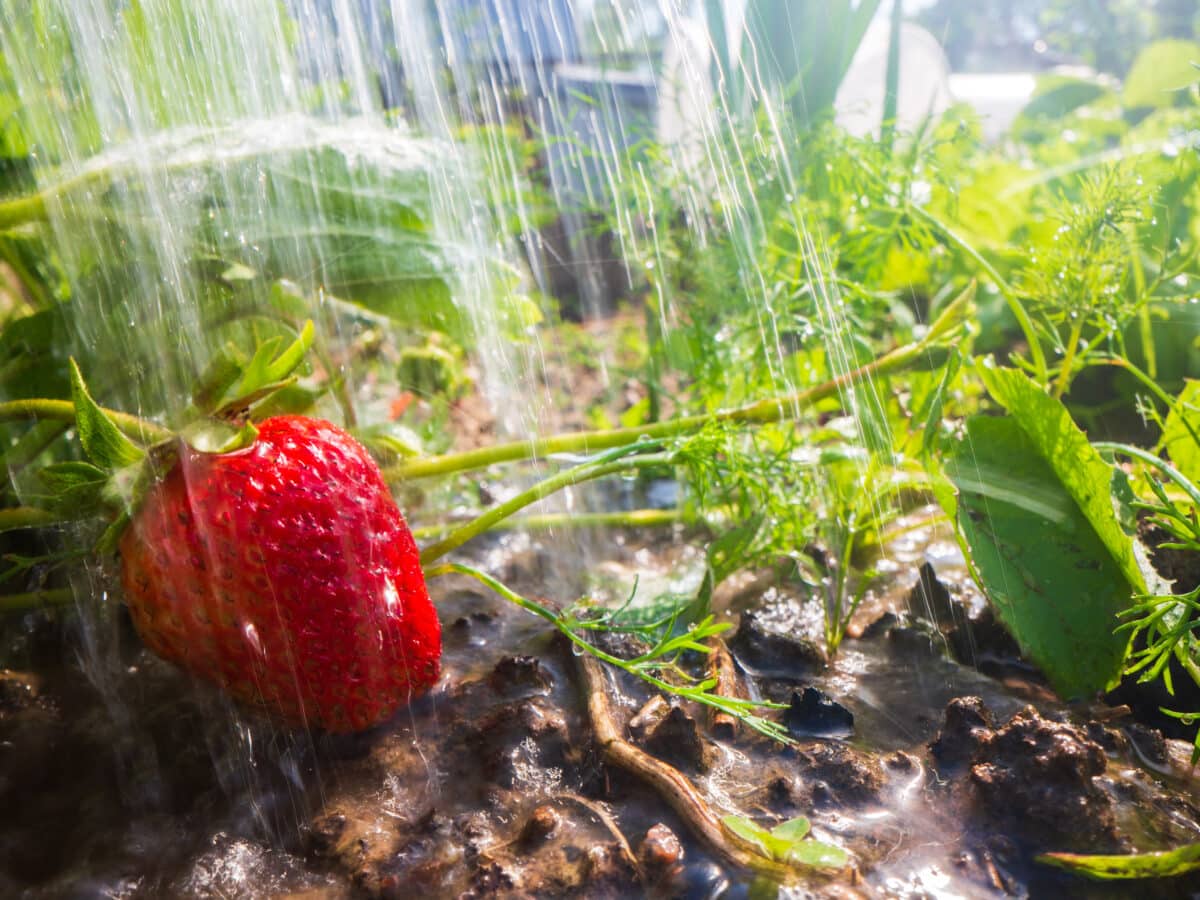
Strawberries have two things working against them with a hose or sprinkler: roots that stay in the top few inches of soil, and fruit that rots the moment it sits in water too long. Drip irrigation solves both at once by keeping water at root level and the berries themselves completely dry.
Matted rows, raised beds, or containers
- Matted row, in-ground: run dripline along each row. Strawberry roots spread wide but shallow, so a line down the row length covers them well.
- Raised beds: the same dripline approach works, and denser spacing is easier to justify since beds drain well and don’t stay soggy. Drip irrigation for raised beds covers the setup.
- Hanging baskets and containers: individual emitters per plant, with more frequent, shorter runs since containers dry out fast, especially a hanging basket exposed to wind on all sides.
Emitter spacing for strawberries
| Setup | Spacing | Flow rate |
|---|---|---|
| Matted row | Dripline, emitters every 12in | 0.5-1 GPH per emitter |
| Dense raised bed planting | Dripline every 9-12in, rows 12in apart | 0.5 GPH |
| Containers or hanging baskets | One emitter per plant | 0.5-1 GPH |
Watering schedule by growth stage
- Establishment, the first few weeks after planting: frequent, light watering, keeping the top inch of soil consistently damp while roots take hold.
- Vegetative growth: deeper, less frequent watering, roughly 1 to 1.5 inches a week.
- Fruiting: this is where consistency matters most. Irregular watering during fruiting is the main cause of soft, watery berries and cracked fruit.
Keeping fruit and foliage dry
Gray mold, or botrytis, is the biggest disease problem in most strawberry patches, and it thrives on wet fruit sitting against damp soil. Drip only wets the soil, never the plant, and paired with a straw mulch underneath the berries, it keeps fruit off wet ground almost entirely. The mulch does as much work here as the irrigation method, and the two together solve most of the problem.
Common mistakes
- Emitters placed too far from the shallow root zone. Strawberry roots don’t reach far, so the emitter needs to be close, not centered on where a bigger plant’s roots would be.
- Reaching for an overhead sprinkler ‘just this once’ during a heat wave. One overhead watering during fruiting can undo weeks of careful drip management.
- Forgetting that containers need almost daily water at peak summer, versus roughly weekly for an established in-ground bed.
Frequently asked questions
Do June-bearing and everbearing varieties need different watering?
The principles are the same for both. Everbearing types just need that consistency held for a longer stretch of the season, since they’re setting fruit multiple times instead of one concentrated harvest.
Can I reuse the same drip layout every year?
For a permanent matted row, yes, the dripline can stay in place for years. Annual plasticulture systems that use drip tape typically don’t survive winter storage well and get replaced each spring anyway.
Do strawberries need less water than tomatoes?
Roughly similar total volume, but delivered differently: shallower and more frequent for strawberries versus deeper and less frequent for tomatoes, because of the difference in root depth. Drip irrigation for tomatoes covers the comparison in more detail.
For the rest of the vegetable garden, drip irrigation for garden plants is the hub guide, with emitter sizing and schedules for everything else you’re growing.