

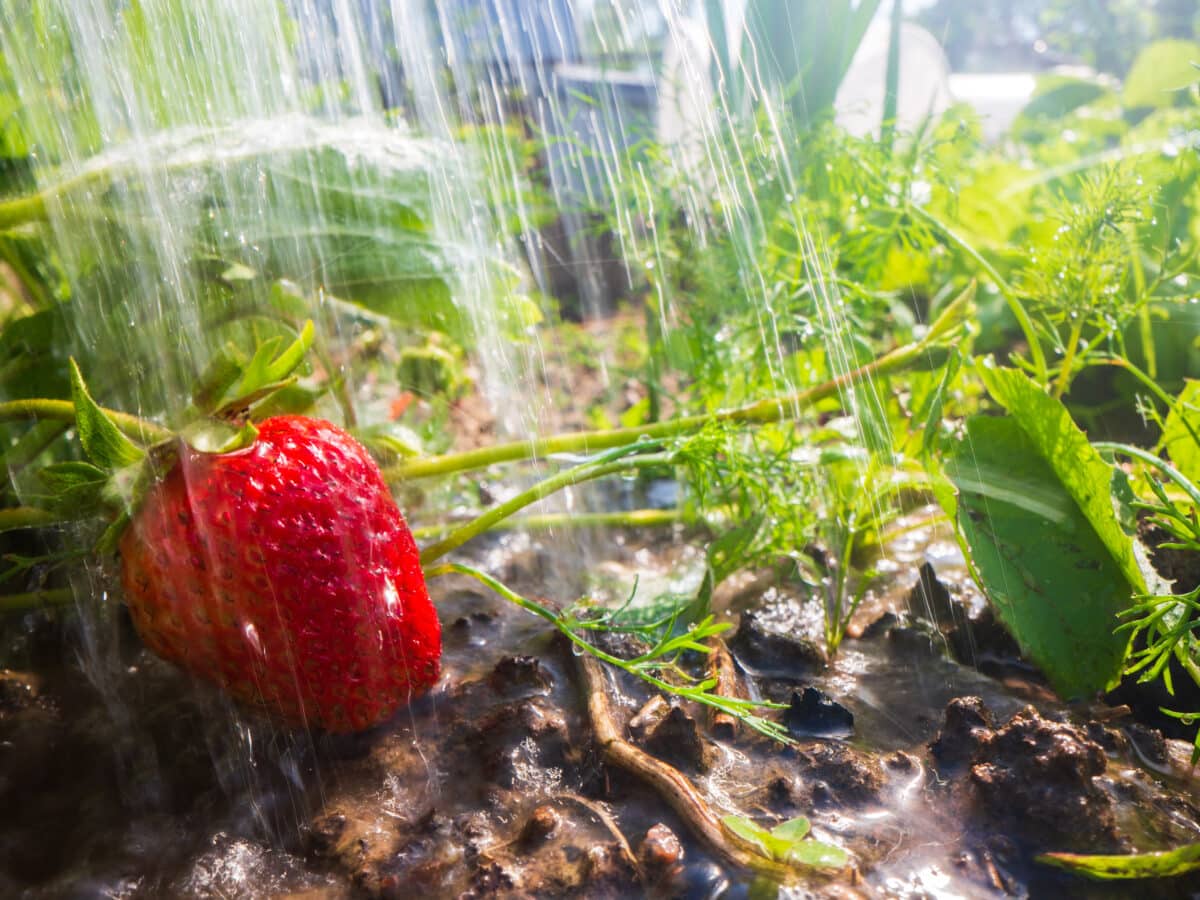
Strawberries have two things working against them with a hose or sprinkler: roots that stay in the top few inches of soil, and fruit that rots the moment it sits in water too long. Drip irrigation solves both at once by keeping water at root level and the berries themselves completely dry.
The catch is that a strawberry patch is less forgiving than a tomato bed. The margin between “moist enough” and “too dry” is a day or two in July, so the layout and the run times below matter more than the brand of kit you buy.
How deep strawberry roots actually go
Most of a strawberry plant’s feeder roots sit in the top 6 inches of soil. A few reach 12 inches in loose ground, but they don’t do much of the drinking. That single fact shapes everything else: water that soaks down to 18 inches is water the plant never uses, and a long, deep soak like you’d give a fruit tree mostly ends up below the root zone.
So the goal with strawberries is shallow and steady. Shorter runs, more often, with the emitter sitting right next to the crown rather than a few inches off to the side.
Matted rows, raised beds, or containers
- Matted row, in-ground: run dripline along each row. Strawberry roots spread wide but shallow, so a line down the row length covers them well.
- Raised beds: the same dripline approach works, and denser spacing is easier to justify since beds drain well and don’t stay soggy. Drip irrigation for raised beds covers the setup.
- Hanging baskets and containers: individual emitters per plant, with more frequent, shorter runs since containers dry out fast, especially a hanging basket exposed to wind on all sides.
Emitter spacing for strawberries
| Setup | Spacing | Flow rate |
|---|---|---|
| Matted row | Dripline, emitters every 12in | 0.5-1 GPH per emitter |
| Dense raised bed planting | Dripline every 9-12in, rows 12in apart | 0.5 GPH |
| Containers or hanging baskets | One emitter per plant | 0.5-1 GPH |
How much water strawberries need, in minutes
The usual advice is 1 to 1.5 inches of water a week once plants are established. That’s hard to act on with a drip system, so here’s the conversion. One inch of water over one square foot is about 0.62 gallons. On dripline with 0.5 GPH emitters every 12 inches, each emitter wets roughly a square foot, which means about 75 minutes of run time puts down an inch.
Split that across the week instead of running it all at once. Remember the roots only go down about 6 inches, and a single 75-minute soak pushes a good share of the water past them.
| Growth stage | How often | Run time per session (0.5 GPH, 12in spacing) |
|---|---|---|
| First 2-3 weeks after planting | Daily or every other day | 10-15 min |
| Vegetative growth | 3 times a week | 25-35 min |
| Flowering and fruiting | 3-4 times a week | 25-35 min, never skipped |
| Heat wave (above 90°F) | Every day | 15-20 min, early morning |
| After harvest (June-bearing) | 2 times a week | 25-30 min |
With 1 GPH emitters, halve those times. Sandy soil wants shorter, more frequent runs; clay holds water longer, so you can stretch the gap between sessions by a day. The trowel test beats any chart: dig 3 inches down beside a plant an hour after the system shuts off. It should feel like a wrung-out sponge. If you want the same logic for the rest of the garden, the drip irrigation watering chart has run times by plant type.
Watering schedule by growth stage
- Establishment, the first few weeks after planting: frequent, light watering, keeping the top inch of soil consistently damp while roots take hold.
- Vegetative growth: deeper, less frequent watering, roughly 1 to 1.5 inches a week.
- Fruiting: this is where consistency matters most. Irregular watering during fruiting is the main cause of soft, watery berries and cracked fruit.
A cheap battery timer earns its keep here. The fruiting weeks are exactly when people go away for a long weekend, and three missed days in June shows up as small, seedy berries a week later.
Drip tape or dripline?
Commercial growers mostly use drip tape: thin-walled, cheap, laid under plastic mulch and thrown out at the end of the season. It works fine at home too, if you grow strawberries as an annual crop and replant each year.
For a perennial matted row that stays put for three or four years, I’d pick 1/2-inch dripline with built-in emitters instead. It costs more per foot, but it shrugs off foot traffic, rakes and the odd trowel, and it survives winter in place. Drip tape in a permanent bed tends to get nicked during weeding and renovation, and one pinhole is enough to flood a section and starve the rest.
Keeping fruit and foliage dry
Gray mold, or botrytis, is the biggest disease problem in most strawberry patches, and it thrives on wet fruit sitting against damp soil. Drip only wets the soil, never the plant, and paired with a straw mulch underneath the berries, it keeps fruit off wet ground almost entirely. The mulch does as much work here as the irrigation method, and the two together solve most of the problem.
Lay the dripline first, then the straw on top. Tucked under mulch, the line stays cooler, evaporation drops, and the water stays where the roots are.
Feeding through the drip line
Strawberries respond well to small, regular feedings during flowering and fruiting, and a drip system makes that easy with a fertilizer injector at the head of the line. Use a water-soluble fertilizer at a weaker dilution than the label’s watering-can rate, and run plain water for the last few minutes of each session so no residue sits in the emitters. Any injector connected to household water needs a backflow preventer upstream of it. That’s a plumbing code requirement in most places, not a suggestion.
Mistakes that cost you berries
The most common one is placing emitters too far from the shallow root zone. Strawberry roots don’t reach far, so the emitter needs to sit close to the crown, not centered on where a bigger plant’s roots would be. The second is reaching for an overhead sprinkler “just this once” during a heat wave: one overhead watering during fruiting can undo weeks of careful drip management. And containers catch people out every summer, because they need almost daily water at peak heat, while an established in-ground bed is fine on the schedule above.
Frequently asked questions
Should I water strawberries every day?
Only in two cases: the first couple of weeks after planting, and containers or hanging baskets in hot weather. Established in-ground plants do better with 3 or 4 shorter sessions a week. Daily watering of a bed that drains slowly keeps the crowns wet and invites rot.
Do June-bearing and everbearing varieties need different watering?
The principles are the same for both. Everbearing types just need that consistency held for a longer stretch of the season, since they’re setting fruit multiple times instead of one concentrated harvest.
Can I reuse the same drip layout every year?
For a permanent matted row, yes, the dripline can stay in place for years. Annual plasticulture systems that use drip tape typically don’t survive winter storage well and get replaced each spring anyway.
Do strawberries need less water than tomatoes?
Roughly similar total volume, but delivered differently: shallower and more frequent for strawberries versus deeper and less frequent for tomatoes, because of the difference in root depth. Drip irrigation for tomatoes covers the comparison in more detail.
Do strawberries need watering in winter?
Dormant plants need very little. Drain and store the system before the first hard freeze, and only hand-water during a long dry spell when the ground isn’t frozen. The drip irrigation maintenance checklist covers shutting the system down properly.
For the rest of the vegetable garden, drip irrigation for garden plants is the hub guide, with emitter sizing and schedules for everything else you’re growing.