

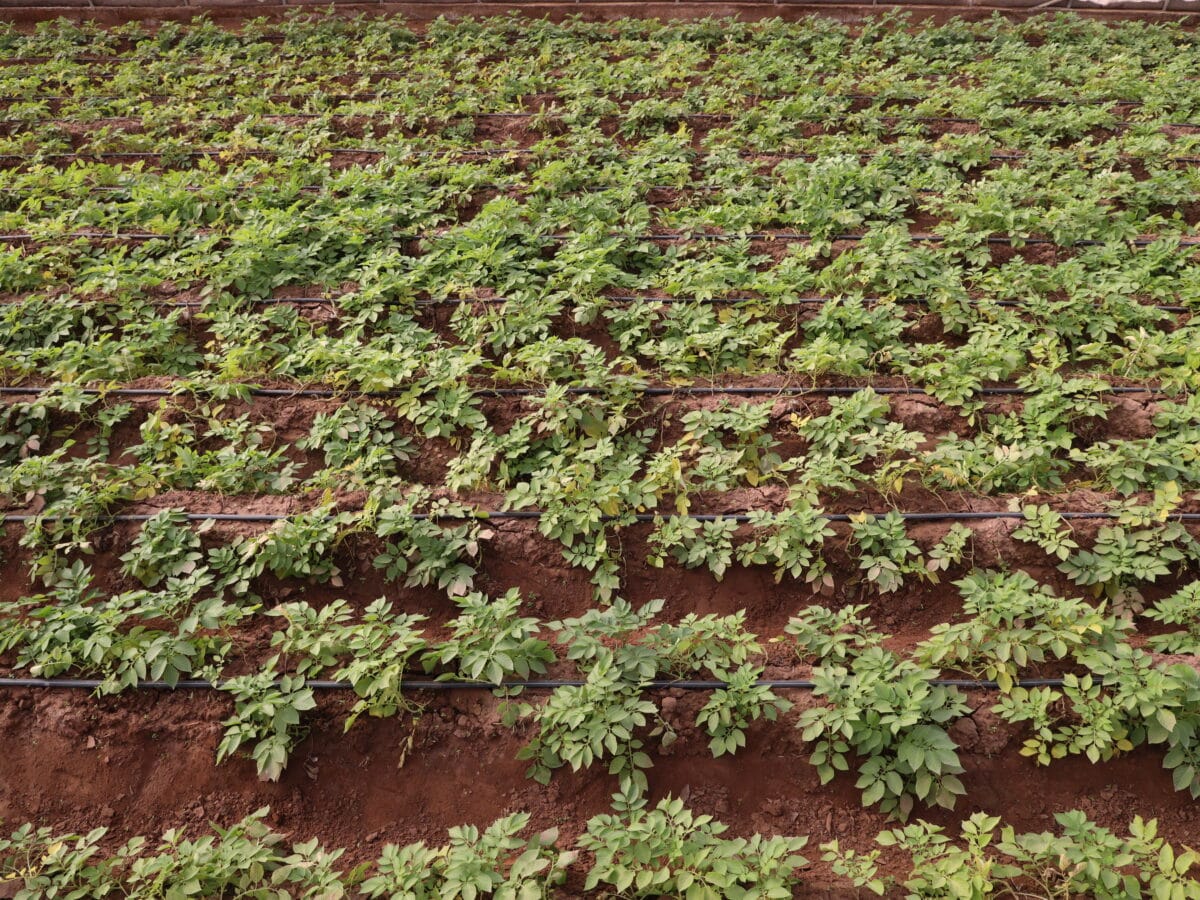
Potatoes don’t wilt dramatically when they’re thirsty, and that’s exactly the problem. The vines can look fine for days after the soil underground has already gone dry. By the time you notice anything above ground, the damage is already set into the tubers: hollow heart, knobby growth cracks, or a flush of common scab that doesn’t show up until you’re digging the crop. Drip irrigation fixes this by taking the guesswork out of the one thing potatoes actually care about, keeping the soil evenly moist through hilling and tuber bulking. Here’s how to lay out a system around hilled rows, how much to run it at each growth stage, and the mistakes that cost you a clean harvest.
Why potatoes are so sensitive to uneven watering
Potato tubers form on underground stems called stolons, usually sitting in the top 8 to 12 inches of soil once a plant is hilled. Unlike a tomato or a squash, a potato plant doesn’t show thirst above ground until the stress has already affected the tubers below, which is why potatoes have a reputation for being finicky about water even though the plant itself looks tough.
Three problems trace directly back to inconsistent watering: hollow heart (a dark, star-shaped cavity inside the tuber, linked to a growth spurt after a dry spell), growth cracks (the tuber splits when it rehydrates and swells fast after being dry), and common scab, which takes hold more easily in soil that dries out during the weeks right after tubers start forming. Drip irrigation doesn’t eliminate scab risk entirely, since soil type and pH play a role too, but it removes the swing between bone-dry and soaked that makes all three worse.
Laying out drip lines around hilled rows
Potatoes get hilled, meaning soil is mounded up around the stems as the plant grows, both to encourage more tubers along the buried stem and to keep developing potatoes covered so they don’t turn green from light exposure. That hilling changes how you’d normally lay out a dripline compared to a crop that just sits flat in the row.
| Setup | Drip layout | Emitter spacing | Flow rate |
|---|---|---|---|
| Traditional hilled row | Dripline laid at the base of the row before the first hilling, then left in place as soil is mounded over and around it | Emitters every 12-18in down the row | 0.5-1 GPH per emitter |
| Raised bed, hilled | Dripline down each row inside the bed, hilled the same way as an in-ground row | Emitters every 12-18in | 0.5-1 GPH per emitter |
| Grow bags or containers | One loop or a single emitter line per bag | 1-2 emitters per container | 0.5-1 GPH each |
Lay the line before the first hilling, not after. If it goes down the middle of the row at planting depth, each hilling pass buries it a little deeper under the mound, which is fine since drip water moves both sideways and down through soil anyway. Trying to thread a dripline through an already-hilled row usually means damaging stems or missing the stolons entirely. Raised bed growers can borrow mainline and zone sizing from drip irrigation for raised beds and apply the same hilling approach inside the bed.
A pressure regulator ahead of the zone is worth having regardless of setup. Potato emitters run at low flow rates, and hose-bib pressure straight out of most spigots is well above what drip tubing and emitters are rated for. Pressure regulator for drip irrigation covers sizing one correctly.
How much and how often, by growth stage
Potato water needs change noticeably as the plant moves from sprouting to tuber bulking, and getting that ramp right matters more than hitting an exact number of minutes. Treat the chart below as a starting point and verify with a soil check, since sandy versus clay soil can shift these numbers meaningfully.
| Growth stage | Run time | Frequency |
|---|---|---|
| Planting to sprout emergence | 15-20 min | Every 3-4 days, soil just needs to stay barely damp |
| Vegetative growth, before hilling complete | 30-40 min | Every 3-4 days |
| Tuber initiation (flowering) | 40-55 min | Twice weekly, this is the stage where a dry spell does the most damage |
| Tuber bulking | 45-60 min | Twice weekly, consistency matters more than total volume |
| 2-3 weeks before harvest | Cut back by roughly a third to half | Once weekly or less, see below |
The general reasoning behind adjusting run time for soil type and season, not specific to potatoes, is covered in how long to run drip irrigation, by plant, soil, and season, and it carries over directly here. Sandy soil drains fast enough that it usually needs the more frequent end of each range; heavy clay holds moisture longer and can often stretch the interval between sessions without shortening the run time much.
Why easing off water before harvest actually helps
This trips people up coming from tomatoes or peppers, where you water right up to the last picking. With potatoes, cutting back water for the final two or three weeks, once the vines start yellowing and dying back on their own, lets the skins toughen up before digging. Thin, immature skin bruises and scuffs during harvest, and that damage is where storage rot starts. Wet soil at digging time also just means more mud clinging to the crop and a higher chance of nicking tubers with the fork. This isn’t a rule to force on a plant that’s still green and actively bulking; it only applies once the vines are naturally starting to die back.
Checking the schedule with a soil check
Charts get a schedule into the right neighborhood, not dialed in for your yard. About an hour after a normal cycle, dig a few inches into the hill near an emitter. It should feel like a wrung-out sponge down to around 6 inches. Bone dry at that depth means add 10 to 15 minutes next time; still soggy a day later means cut the run time back, since waterlogged soil around developing tubers invites rot faster than a dry patch invites scab.
Common mistakes with potatoes and drip irrigation
- Letting the soil dry out during tuber initiation. This is the single costliest mistake on the list. A dry spell right as the plant starts setting tubers can cut yield hard, even if watering gets back on track right after.
- Switching to overhead watering during a hot stretch. Potato foliage is prone to early and late blight, and wet leaves sitting damp overnight is exactly the condition that gets a fungal problem started in a patch that was otherwise fine.
- Keeping a flat schedule from planting through harvest. A system left on autopilot either underfeeds the plant during bulking or waters down skin quality right before digging.
- Burying the dripline too deep on the last hilling pass. Water still reaches the stolons from several inches down, but a line buried too deep in sandy soil can leave the top of the hill drier than it looks.
- Harvesting right after a heavy watering. Give the soil a few dry days before digging; it’s easier on the tubers and your boots.
FAQ
How much water do potatoes need per week?
As a starting point, established plants during active growth generally want the equivalent of 1 to 2 inches of water a week, split across two sessions rather than one long soak. That climbs slightly during tuber bulking in hot weather and should taper off in the final two to three weeks before harvest. Adjust based on a soil check rather than treating this as a fixed number for every yard.
Can I use a soaker hose instead of drip irrigation for potatoes?
Yes. For a straightforward hilled row, a soaker hose laid at the base before hilling wets a similar strip of soil. It’s harder to dial in precise, lower flow rates the way individual emitters allow, and a hose buried under a mound of soil is more work to inspect for clogs mid-season. Drip irrigation for tomatoes covers a similar comparison for another crop often grown the same way.
Should I stop watering potatoes completely before harvest?
Not completely, just scaled back. Cutting water off entirely once vines are still partly green can stress the plant without any real benefit to skin set. Reducing the run time by roughly a third to half for the final two to three weeks, once the vines are naturally yellowing, is the more common approach among gardeners aiming for potatoes that store well.
How do I know if I’m overwatering my potato plants?
Yellowing lower leaves on an otherwise healthy-looking plant, soil that stays wet a day or more after a cycle, and soft or rotten tubers at harvest despite a decent-looking crop above ground are the main signs. Overwatering during bulking is also one of the more common causes of lenticel growths, the small bumps that appear on a tuber’s skin when it’s been sitting in waterlogged soil.
Lay the line before the first hilling, keep the schedule steady through tuber initiation and bulking, and ease off in the final stretch before digging. A soil check a week into the season will tell you whether the run times above need nudging for your soil. For sizing and scheduling the rest of a mixed vegetable garden, not just the potato row, drip irrigation for garden plants is the hub guide covering the other crops plant by plant.