

Drip tubing comes in a handful of sizes with unhelpful names, and picking wrong is how you end up with a system where the last plant in the row gets a sad little seep. Here’s what each size is for, with the actual numbers.
The sizes that exist
Ignore the marketing names (“universal,” “pro”) and go by diameter:
- 1/4 inch (about 4-6mm) — micro tubing. The spaghetti that branches to individual plants.
- 1/2 inch (about 16-17mm) — the standard mainline for home gardens. When a guide says “mainline,” it means this.
- 5/8 inch — an intermediate size for longer runs. Less common in kits.
- 3/4 inch and 1 inch — supply lines for big properties and multi-zone manifolds. Most home gardeners never need them.
One annoyance to know upfront: “1/2 inch” varies slightly by brand (0.600 vs 0.620 vs 0.700 inch internal diameter are all sold as half-inch). Fittings from one brand mostly fit another, but “mostly” does some work there. Sticking to one brand per system saves swearing.
Capacity and run length: the numbers that bite
Tubing has two limits: how much water it can carry (flow) and how far it can carry it before friction eats the pressure (run length):
| Size | Max flow | Max single run |
|---|---|---|
| 1/4 inch micro | ~30 GPH | ~30 feet |
| 1/2 inch mainline | ~240 GPH (4 GPM) | ~200 feet |
| 5/8 inch | ~380 GPH | ~300 feet |
| 3/4 inch | ~700 GPH | ~500+ feet |
These are working limits at drip pressures, not theoretical maxima. Stay inside them and pressure-compensating emitters take care of the rest. Exceed them and no emitter technology rescues the far end.
The flow limit does the math for zone sizing: add up your emitters’ GPH. Fifty 1 GPH emitters and a hundred feet of 0.6 GPH dripline (60 emitters’ worth) totals about 86 GPH, comfortably inside 1/2-inch territory. Past roughly 200 GPH, split into two zones or step up the mainline.
1/4-inch micro tubing: the branch lines
Micro tubing’s job is the last few feet: from the mainline to the plant. Two rules keep it honest:
- Keep runs short. Under 30 feet, and under 15 is better. It’s skinny, and friction in skinny tubes is brutal.
- One emitter per line, mostly. Stringing five button emitters on one 1/4-inch branch gives the first one everything and the last one a sigh.
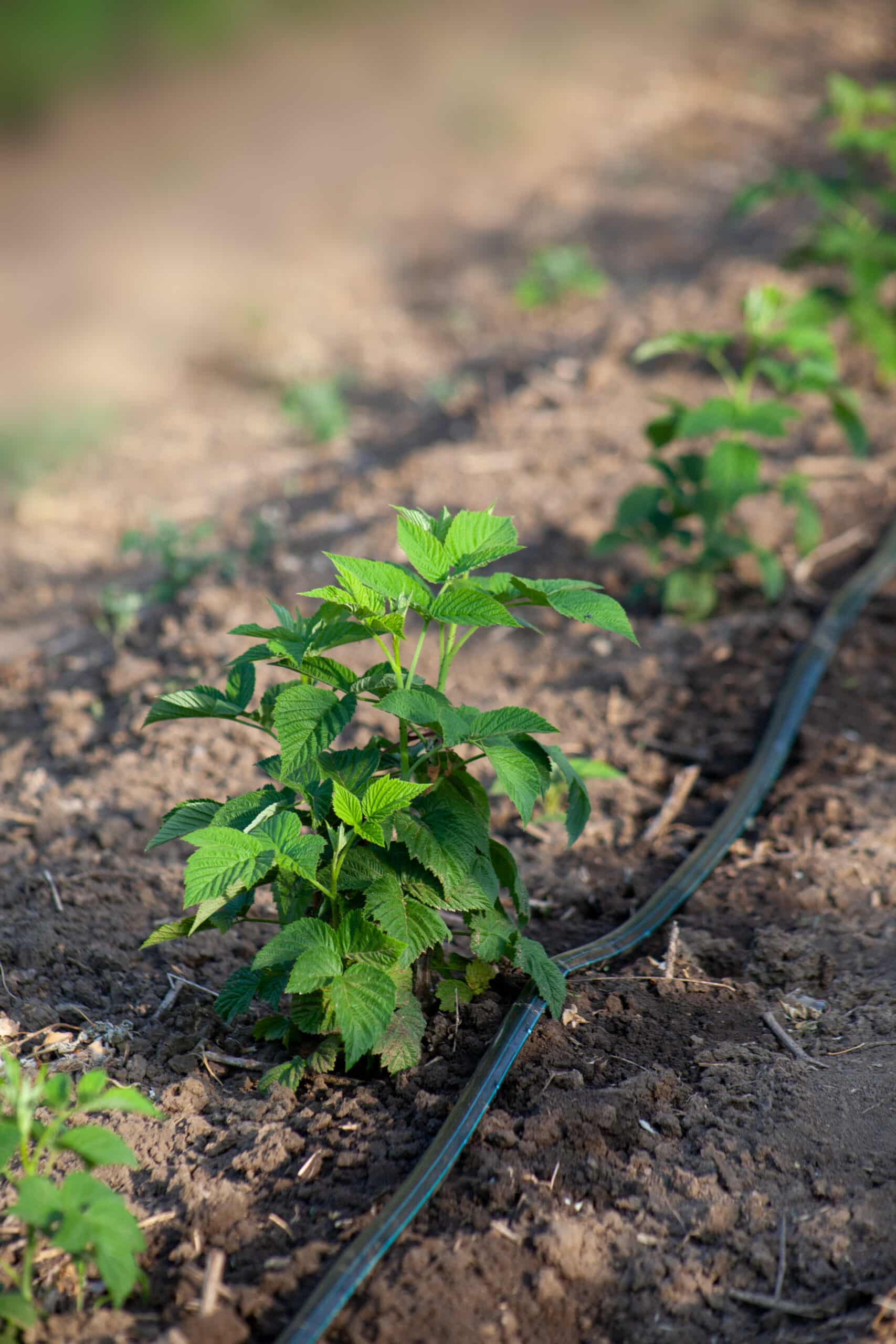
Dripline is the exception: it’s 1/4-inch tubing with emitters engineered in, spaced 6 to 18 inches apart, designed to water evenly along its length. Rows and beds love it, as covered in drip irrigation for raised beds.
Poly vs vinyl, and the sunlight question
Polyethylene (poly) is the stiff black tubing that mainlines are made of. It resists UV reasonably well, holds barbed fittings by friction, and lasts 10 to 20 years in place. Stiff is good: it stays where you stake it.
Vinyl is the softer, more flexible stuff sold as micro tubing. Easier to route around pots and bed corners, shorter-lived in direct sun.
Either way, mulch is the fountain of youth: two inches of cover blocks the UV that embrittles both, and systems under mulch outlive exposed ones by years.
Fittings: the matching game
Barbed fittings work by being slightly bigger than the tube’s inner diameter; you force the tube over the barb and it grips. Practical tips:
- Warm tubing pushes on easier. Sun, or ten seconds in hot water for stubborn cases.
- Push until the tubing covers all the barbs. Half-seated fittings weep and eventually launch themselves.
- Goof plugs seal mistaken punches. Buy the little bag; you will punch a hole in the wrong spot.
- Compression and locking fittings cost more and grip harder. Worth it at the few permanent joints, like the spigot adapter; barbs are fine everywhere else.
Planning for expansion
Design habit worth having: size the mainline one step beyond today’s plan. If your zone math lands near 150 GPH on 1/2-inch tubing, that’s fine now, but next year’s new bed puts you over. Running 3/4-inch for the backbone costs a few dollars more and makes the expansion a tee fitting instead of a rebuild. The zone layout context is in DIY drip irrigation system.
FAQ
Is 1/2-inch tubing enough for a vegetable garden?
For almost every home vegetable garden, yes. It carries about 240 GPH and runs 200 feet, enough for dozens of emitters across several beds.
Can I connect 1/4-inch tubing directly to the spigot?
You can, with the right adapter, but you shouldn’t: the spigot feeds more flow than micro tubing can handle, and the pressure is wrong anyway. Spigot to head assembly to mainline to micro tubing is the chain. The head assembly order is in how to install drip irrigation.
What happens if my mainline is too long?
Pressure falls with distance, so emitters at the far end flow less, then barely at all. The fix is splitting the run into two zones or feeding the line from the middle with a tee.
Does tubing color matter?
Black is standard and UV-stabilized. Brown or purple dripline exists for landscaping and reclaimed water respectively. Performance-wise, same stuff; pick on looks and local code.
Learn the two limits (flow and run length), keep micro tubing short, and the sizing question answers itself. For the emitters that hang off these tubes, see drip irrigation emitters, and the rest of the parts series lives in Components & Parts.