

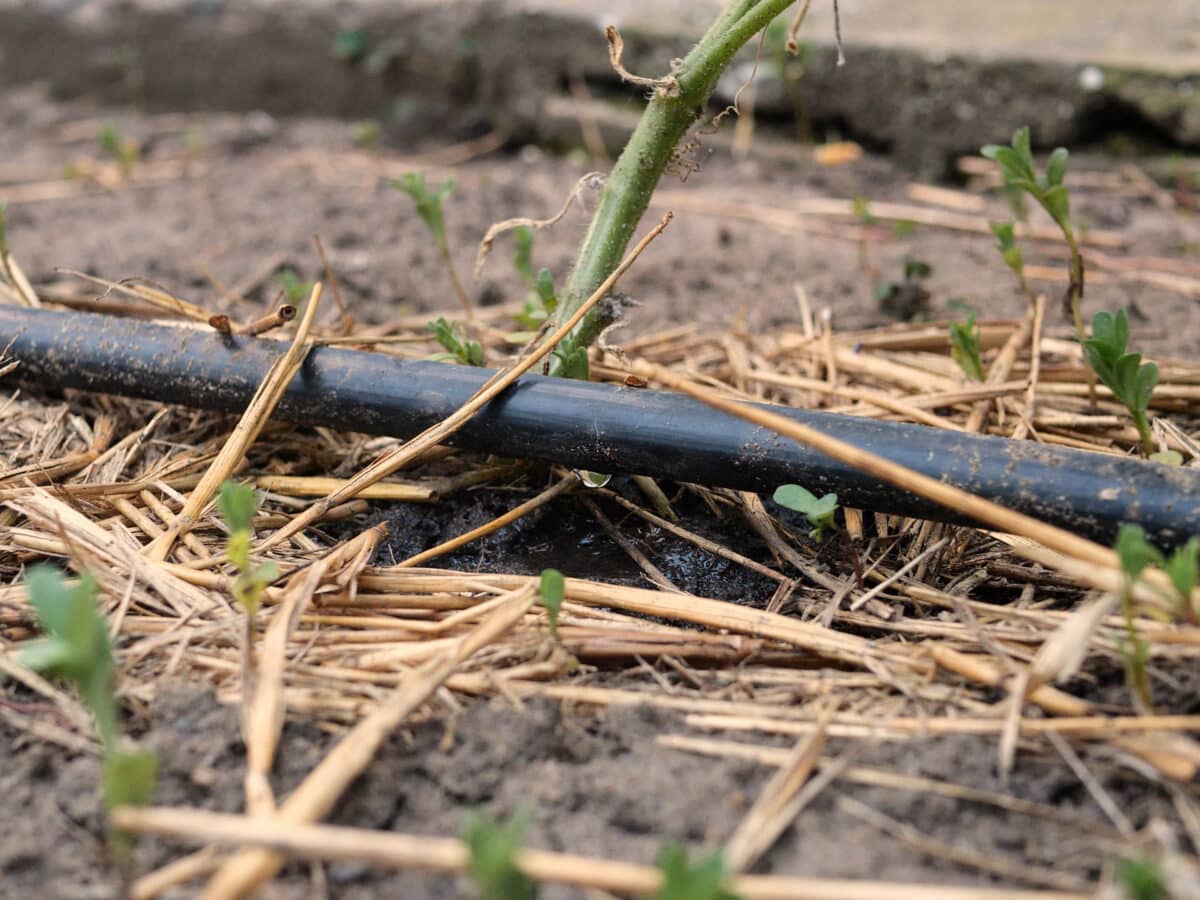
Vegetables want 1 to 1.5 inches of water a week, most of the time. Turning that into drip run time depends on three things: your emitter’s flow rate, how many emitters are actually covering each plant, and what you’re growing. A lettuce bed and a row of tomatoes don’t want the same schedule, and a raised bed drains differently than a ground row. Here’s the math, a chart to start from, and a worked example so you’re not guessing.
The short answer
For a vegetable bed running 1 GPH emitters (or 0.5 GPH dripline at 12-inch spacing) on average garden soil, plan on 30 to 60 minutes per session, 2 to 3 times a week during the growing season. Leafy greens and seedlings sit at the low end. Fruiting vegetables like tomatoes, peppers, and squash sit at the high end once they’re carrying fruit. That’s a starting point, not a fixed number, since your soil, climate, and exact hardware will nudge it up or down.
Turning inches of water into minutes of drip time
The standard extension-service guideline is 1 to 1.5 inches of water per week for most vegetables, rain included. In gallons, 1 inch of water over 100 square feet works out to about 62 gallons. From there, the run time is just division: how many gallons you need, divided by how many gallons your emitters deliver per hour.
- Weekly gallons needed = 0.62 x square footage x inches of water per week
- Total emitter output = number of emitters x GPH per emitter
- Weekly run time = weekly gallons needed ÷ total emitter output, converted to hours, then split across 2 to 3 sessions
A worked example
Take a 4×8-foot raised bed of peppers, 32 square feet, with two rows of dripline running 1 GPH emitters spaced 12 inches apart, 16 emitters in total, so 16 GPH combined. At 1.5 inches a week, that bed needs roughly 30 gallons. 30 gallons divided by 16 GPH is just under 2 hours of total run time a week. Split across three sessions, that’s about 35 to 40 minutes each, which lines up neatly with the chart below for fruiting vegetables.
Run times by vegetable type and stage
Assuming 1 GPH emitters (or equivalent dripline) on loam soil. Sandy soil: shorten these by about a third and water more often. Clay soil: lengthen them and water less often, since clay holds moisture longer.
| Vegetable / stage | Run time | Frequency |
|---|---|---|
| Seedlings & new transplants (first 2 weeks) | 10-15 min | Daily, or every other day |
| Leafy greens (lettuce, spinach, chard, kale) | 20-30 min | Every 1-2 days |
| Root vegetables (carrots, beets, radishes) | 25-35 min | Every 2 days |
| Fruiting vegetables, before fruit set (tomatoes, peppers, squash) | 30-45 min | Every 2 days |
| Fruiting vegetables, once fruiting (tomatoes, peppers, cucumbers) | 45-60 min | Every 1-2 days |
| Vining crops (melons, winter squash, pumpkins) | 45-60 min | Every 2-3 days |
Tomatoes specifically punish inconsistent watering with blossom end rot and split fruit, so a steady rhythm matters more than the exact minutes. The full breakdown, including emitter spacing around the root ball, is in drip irrigation for tomatoes.
Why emitter GPH and spacing change the math
The chart above assumes 1 GPH emitters. Halve that to 0.5 GPH and you roughly double the run time for the same amount of water. Dripline works the same way through spacing: tubing with emitters every 6 inches puts down water faster per foot of row than the same tubing spaced at 12 or 18 inches, because there are simply more emitters doing the work along that same stretch of bed. Before trusting any chart, check what’s actually installed. Cheap dripline and premium dripline are both commonly rated at 0.4 to 0.6 GPH per emitter, but point-source emitters range anywhere from 0.5 to 4 GPH, and mixing types on one zone is a common reason a “correct” run time still leaves half the bed dry.
New transplants vs. established plants
A transplant’s root ball is a few inches wide and dries out fast. That’s the reason seedlings and new transplants get short, frequent sessions rather than one long soak, even though the total weekly water is less than a mature plant needs. As roots spread outward and downward over the first few weeks, stretch the interval and add a few minutes to each session, then transition to the full-grown numbers in the chart once the plant is established, usually 3 to 4 weeks after transplanting for most vegetables.
Raised beds need their own adjustment
Raised beds drain faster than in-ground rows, because the soil mix is looser and the bed has more exposed surface area relative to its volume. The vegetable numbers above and the general raised bed numbers land in a similar range, but raised beds skew toward more frequent watering rather than longer sessions. If most of your growing space is in raised beds rather than ground rows, the full layout and emitter-spacing guide is in drip irrigation for raised beds.
Check it with a dig test
Charts get you close, not exact. A week after setting a schedule, run a normal session, wait an hour, then dig down 4 to 6 inches near an emitter. The soil should feel like a wrung-out sponge at that depth: cool, holding together, not dripping. Dry below 2 inches means add 50 percent to the run time and retest; mud or water squeezing out means cut it back by a third. The full version of this test, along with seasonal adjustments and warning signs like midday wilting or yellowing leaves, is in how long to run drip irrigation, by plant, soil, and season. For laying out a whole vegetable garden’s drip system from scratch, emitters and all, start with drip irrigation for garden plants: the full guide.
FAQ
How long to run drip irrigation for new plants?
10 to 15 minutes, daily or every other day, for the first two weeks after transplanting. New root balls are small and dry out quickly, so short and frequent beats long and rare until the roots spread out. Taper to the full-grown schedule for that vegetable once it’s established.
How long to run drip irrigation for 1 inch of water?
It depends entirely on emitter output. One inch of water over 100 square feet is about 62 gallons. Divide that by your total emitter GPH for the area to get the hours needed, then convert to minutes. Ten 1 GPH emitters covering 100 square feet, for example, need a little over 6 hours to deliver a full inch. Most schedules split that across several shorter sessions instead of running it all in one go.
How long to run drip irrigation for raised beds?
Usually 30 to 60 minutes per session at the same frequency as in-ground vegetables, maybe slightly more often since raised bed mix drains faster. The exact number still depends on emitter GPH and bed size, so run the math above rather than borrowing a number from a bed a different size than yours.
Do I need to run drip irrigation longer once vegetables start fruiting?
Usually yes, and it’s the single biggest jump in the chart above. Fruiting vegetables like tomatoes and peppers are pulling more water to size up fruit, and inconsistent moisture at this stage is what causes blossom end rot and cracking. Increase run time rather than frequency where possible, since deep watering during fruiting still beats frequent shallow watering for root health.
Set the run times from the chart, verify with the dig test, and adjust once fruiting starts. More watering guides for specific plants and setups live in Watering Schedules.