

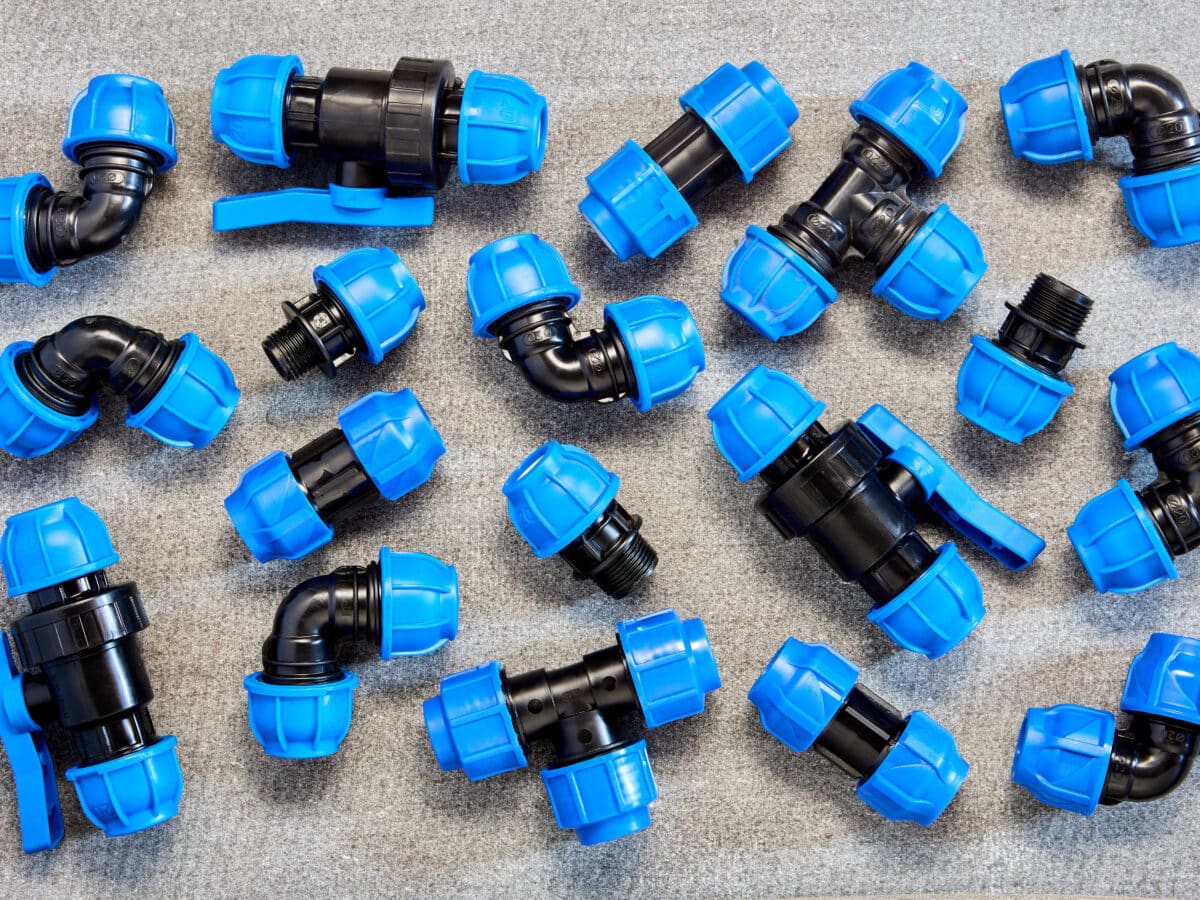
Most soaker hose problems that look like a hose problem are actually a fitting problem. A coupling that’s one size off, a tee that never got fully seated, an end cap left cracked open all winter, any of these mimics a “broken hose” symptom without the hose itself being at fault. Once you know the handful of fittings a soaker hose setup actually uses, building and troubleshooting around them gets a lot faster.
The fittings you’ll actually use
A soaker hose setup rarely needs more than four or five fitting types, no matter how many beds you’re feeding.
- Barbed couplings. A ridged plastic tube that joins two cut ends of hose, or repairs a section you’ve cut out. Push the hose over the barbs; on stiff rubber, warming it in the sun first makes this a lot easier.
- Compression or threaded couplings. Screw-together fittings for hose ends that already have male or female garden-hose threads, common where a soaker hose meets a leader hose.
- Tee and wye connectors. Split one incoming line into two outgoing ones, used to branch a single spigot connection into two separate beds or two loops within one bed.
- End caps. Close off the far end of a run. Some soaker hoses come with one preinstalled; others need a separate cap or a fold-and-clamp.
- Hose-thread adapters. Step a fitting up or down between the standard 5/8-inch garden hose thread and the narrower tubing some drip and soaker kits use.
Sizing: the detail that causes most leaks
Soaker hoses aren’t all the same outside diameter, even at the same nominal size. A fitting sized for 1/2-inch tubing will not seal on 5/8-inch hose no matter how hard you push it, and forcing it usually just splits the hose end. Before buying fittings, measure the actual outside diameter of your hose with a tape measure rather than trusting the size printed on the original packaging, since “standard” varies more between brands than it should.
| Common size | Typical use | Fitting compatibility note |
|---|---|---|
| 3/8 inch | Compact drip and soaker kits, small raised beds | Needs 3/8-specific barbs; standard garden fittings won’t fit |
| 1/2 inch | Most budget soaker hoses | Widest fitting availability |
| 5/8 inch | Standard garden-hose-diameter soaker hoses | Fits most universal barbed couplings |
Connecting two lengths of hose in a single run
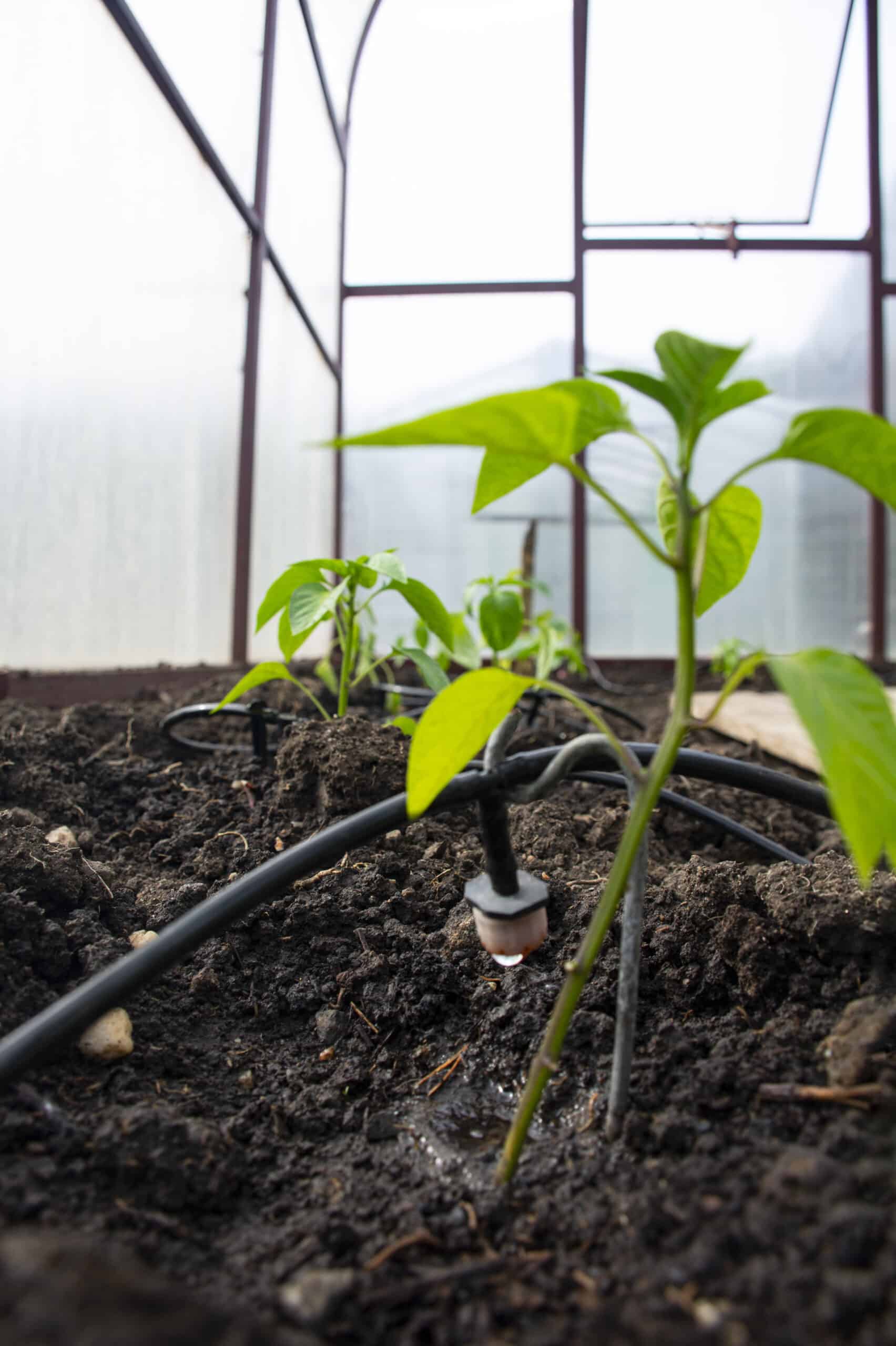
- Cut both hose ends square with a sharp utility knife, a ragged cut makes a poor seal.
- Warm the ends in the sun for a few minutes if the hose feels stiff.
- Push each end onto a barbed coupling until it seats against the center ridge.
- Secure with a hose clamp if the fitting doesn’t grip tightly on its own; cheap barbed couplings sometimes need the extra hold, especially on rubber hose that’s already a season or two old and slightly stretched.
- Test at low pressure before covering with mulch, checking the joint itself for any weeping that isn’t coming through the hose’s own pores.
Treat a coupled connection the same as a single continuous hose for length purposes. Two 25-foot sections joined together still add up to a 50-foot run, and the far end still starts to lag past roughly 100 feet total.
Branching one spigot into several beds
A tee or wye connector at the spigot end lets one water source feed two separate soaker hose runs, useful for a pair of raised beds that don’t sit in a straight line. Each branch after the tee should still follow the same length rules as a single run, and if the two branches are very different lengths, expect the shorter one to run at slightly higher pressure and put out a bit more water unless you add a second pressure regulator to balance them. For more than two branches, a small manifold with individual shutoff valves per line gives the most control, letting you turn off one bed without stopping water to the others.
Capping and looping the far end
A dead-end cap is the simplest option and works fine for a single straight or serpentine run. If you’d rather loop the hose back toward the start, a return connector lets you tie the far end back to a second parallel line, which can even out pressure across a wide bed since water approaches the far corners from two directions instead of one. It’s more fitting work up front, but I use it on beds wider than about 4 feet, where a single serpentine pattern starts leaving weak spots in the middle.
Where fittings tend to leak, and how to stop it
Barbed couplings pushed on cold. Cold rubber doesn’t stretch enough to seat fully against the barb ridges, leaving a gap. Warm the hose first, every time.
Threaded connections that were only hand-tightened loosely. Hand-tight is the right amount of force for most soaker hose fittings, but “hand-tight” still means snug, not just resting together. A quarter turn past finger-resistance is usually the sweet spot.
Tee connectors with one branch capped wrong. If you’re only using one side of a tee for now, cap the unused branch properly rather than folding the hose over and clamping it; a folded cap under pressure eventually works itself loose.
Mismatched sizes forced together. This is the one that actually damages hose ends. If a fitting doesn’t slide on with firm, steady hand pressure, it’s the wrong size, not a fitting that just needs more force.
FAQ
Can I use regular garden hose fittings on a soaker hose?
Standard garden-hose-thread fittings work fine at the ends where a soaker hose meets a leader hose or spigot, since most soaker hoses match that 5/8-inch thread standard. Fittings meant to join two lengths of the porous section itself, barbed couplings, need to match the hose’s actual outer diameter rather than the thread standard.
How many soaker hoses can I connect in one line?
There’s no hard fitting limit, but the practical one is pressure: once the combined length passes roughly 100 feet, the far end starts to underperform no matter how many couplings sit in between. Two or three shorter runs from a splitter beat one long chained line.
Do I need a separate fitting for each raised bed?
Not necessarily. A tee or manifold with individual valves lets several beds share one spigot connection while still letting you shut off water to one bed without affecting the others.
What size soaker hose fitting do most kits use?
Most home garden kits use either 1/2-inch or 5/8-inch hose, and a 5/8-inch universal barbed coupling fits the widest range of brands. When in doubt, measure the hose rather than guessing from the box it came in.
Fittings are the unglamorous part of a soaker hose setup, but a $2 coupling put on correctly is the difference between a system that runs itself for years and one you’re troubleshooting every June. For the full spigot-to-mulch process these fittings fit into, see how to install a soaker hose, and if something’s already installed but not weeping right, soaker hose not working walks through the pressure and connection checks in order.