

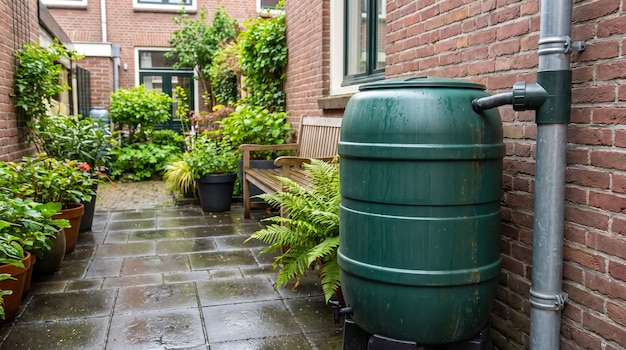
The pillar guide on this site gets asked “can I run drip irrigation off a rain barrel” often enough that it earned a one-line FAQ answer: only with a pump. That’s true, but it’s the short version, and the long version is more useful if you’re actually standing next to a barrel wondering what to do with it.
Why straight gravity doesn’t work
Water pressure from height follows a fixed rule: about 0.433 PSI for every foot of elevation. A standard drip emitter needs somewhere around 15 PSI minimum to open and flow evenly, and 20 to 25 PSI is closer to where most tubing and emitters are actually rated. Run the math backward and a barrel would need to sit roughly 35 feet in the air to hit even the low end of that range on gravity alone. Nobody is mounting a 55-gallon barrel on a three-story platform for a tomato bed.
Most rain barrel kits sold as “gravity-fed drip irrigation” sit a foot or two up on a simple stand, which nets something like 0.5 to 1 PSI. That’s not enough to open a standard pressure-compensating emitter at all. It’s enough to slowly seep out of an open soaker line or gravity-rated drip tape with nothing restricting it, which is exactly why gravity barrels and pressure-compensating emitters get sold together as if they’re interchangeable when they aren’t.
What actually works without a pump
Non-pressure-compensating gravity drip tubing, sold specifically for barrel and tote setups, will trickle at low elevation because it isn’t trying to hold a fixed flow rate against pressure the way a regular emitter does. A soaker hose run downhill from a barrel on a low stand does the same thing. Both work for a handful of plants close to the barrel, watered slowly over an hour or more, with flow that varies by how full the barrel currently is. That’s a real setup for two or three containers or a short row right next to the barrel. It’s not a zoned system, and it’s not going to reach the far end of a 40-foot bed evenly.
What actually works well: adding a small pump
A 12V DC pump, solar or battery powered, gets a barrel up to the 15 to 25 PSI range drip parts expect. That’s the same hardware covered in solar-powered drip irrigation if there’s no outlet nearby. If power is closer at hand, a small submersible utility pump dropped straight into the barrel, wired to a regular outlet, does the same job for less money and without worrying about sun exposure. Either route, the pump is what turns “gravity-fed” from a slow trickle into an actual drip zone.
Three setups, compared
| Setup | Pressure achieved | Best for | Main limitation |
|---|---|---|---|
| Gravity only, barrel on a low stand | 0.5-1 PSI | A few containers right next to the barrel | Uneven flow, drops off fast with distance |
| Barrel + small 12V DC pump | 15-40 PSI | One real drip zone, off-grid plots | Needs a battery, solar or otherwise |
| Barrel + 110V submersible utility pump | 20-50 PSI | Any zone where an outlet is within reach | Tied to an extension cord and GFCI outlet |
Filtering rainwater matters more than tap water
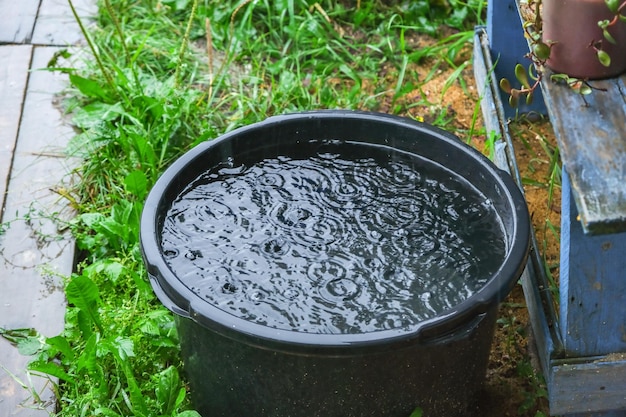
Roof runoff carries grit, leaf litter, and whatever’s nesting in the gutters, and a barrel sitting uncovered for a season adds algae and mosquito larvae to the mix. All of that is worse for emitter clogging than treated tap water, so a screen filter isn’t optional here the way it might feel optional on a small tap-fed bed. A first-flush diverter on the downspout keeps the worst of the roof grit out of the barrel in the first place, and the filter guide covers mesh sizes for the inline screen that should sit right before the emitters regardless.
Sizing the barrel so you don’t run dry mid-cycle
A 55-gallon barrel feeding a zone of 10 emitters at 1 GPH each, run for 45 minutes, uses about 7.5 gallons a session. That’s roughly seven sessions before a refill, which covers a small bed watered every other day for close to two weeks if rain keeps topping off the barrel. During a dry July stretch with no rain to refill it, that math falls apart fast. Treat a rain barrel as a supplement to a spigot connection, not a sole water source, unless it’s genuinely oversized for the bed it’s feeding or you’re prepared to haul water to refill it by hand.
Mistakes worth avoiding
- Buying pressure-compensating emitters for a gravity-only setup. They need real pressure to open at all; use gravity-rated drip line instead if there’s no pump in the picture.
- Skipping the screen filter because the water “looks clean.” Algae and fine sediment you can’t see are what actually clog an emitter opening.
- Forgetting the regulator once a pump is added. Same rule as any drip system: the regulator goes after the pump, not before, same as it goes after a spigot timer.
- Assuming barrel volume tracks roof size on a schedule. It refills when it rains, not on a calendar, so plan for stretches with none.
FAQ
Can I run a full drip irrigation system off a rain barrel?
One zone, realistically, unless the barrel is paired with a pump sized for more. Gravity alone from barrel height can’t reach the pressure standard emitters need, and barrel volume runs out faster than most people expect once you do the math on gallons per session.
Do I need a pump for a rain barrel drip system?
If you want standard pressure-compensating emitters and even coverage across a real bed, yes. Without a pump you’re limited to gravity-rated drip line or a soaker hose watering a small area close to the barrel.
What’s the difference between gravity-rated drip line and regular drip line?
Regular pressure-compensating emitters need roughly 15 PSI or more to open and hold a fixed flow rate. Gravity-rated line skips that mechanism, so it trickles at very low pressure but the flow rate varies with how full the barrel is rather than staying fixed.
How often does a rain barrel need refilling for drip irrigation?
Depends entirely on zone size and rainfall. A 55-gallon barrel feeding one small bed lasts a week or two between rains; a larger zone or a dry stretch empties it much faster. Check it the way you’d check a fuel gauge, not on a fixed schedule.
A rain barrel is a genuinely useful piece of a drip system once the pressure math is out in the open, it’s just not the standalone system some product listings imply. Pair it with a small pump and a decent filter and it holds up fine for a bed or two. The full parts breakdown, filter included, is in drip irrigation components and parts explained.