

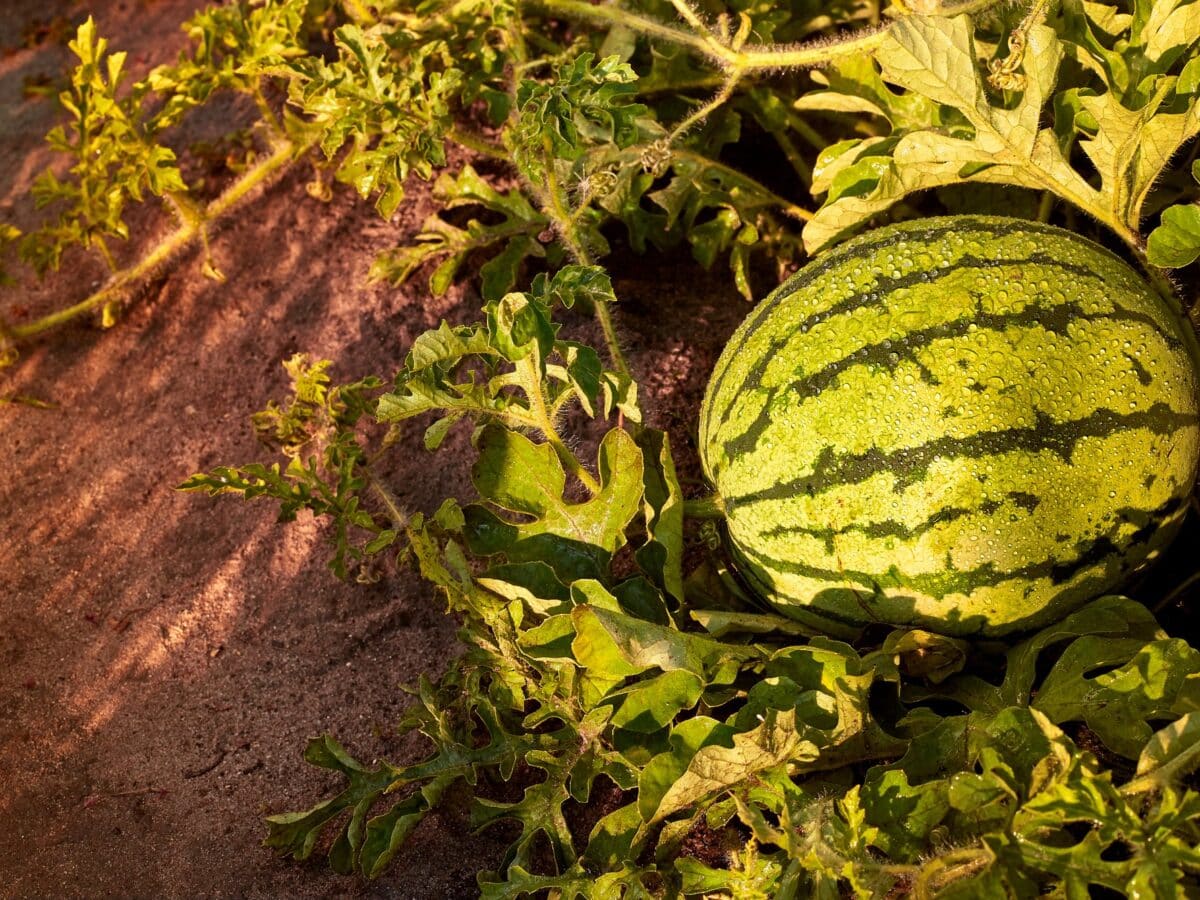
Watermelon vines look like they can shrug off a dry week, and for a few days they can. Then the leaves go dull, the fruit stalls out at softball size, and the melons you do get taste like wet cardboard instead of sugar. Watermelon is one of the least forgiving crops when it comes to watering consistency, not total volume, and a hose dragged across the patch every few days rarely gets that consistency right. Drip irrigation does, because it puts the same amount of water in the same spot every time. Here’s how to lay it out, how much to run it through the season, and the one watering mistake that ruins flavor even when everything else goes right.
Why watermelon is so sensitive to watering swings
A watermelon vine roots wide and shallow. The main root system spreads out several feet from the crown, mostly sitting in the top 12 inches of soil, chasing moisture rather than digging deep for it. That shallow spread is efficient at soaking up water fast, but it also means the plant has almost no reserve to fall back on when the top layer of soil dries out. A tomato with deeper roots can coast through a missed watering. A watermelon vine mostly can’t.
That sensitivity shows up in three ways gardeners run into constantly: blossom drop when the vine is stressed during flowering, hollow heart (a crack or void inside the melon linked to irregular watering during rapid fruit sizing), and foliar disease, mainly powdery and downy mildew, which spread fastest on leaves that get wet from overhead watering and stay damp overnight. Drip irrigation solves the consistency problem and the wet-leaf problem in the same move, since water goes to the soil at the root zone and the vine’s sprawling leaves never get touched.
Laying out drip lines for hills, rows, or a raised bed
Watermelon is usually planted one of three ways in a home garden, and each wants a slightly different drip layout.
| Planting method | Drip layout | Emitter spacing | Flow rate |
|---|---|---|---|
| Hills (2-3 plants per mound) | Ring of emitters or a small drip loop around each hill | 3-4 emitters per hill, 12-18in from the crown | 1-2 GPH each |
| In-ground rows | Dripline laid straight down the row, following the vine | Emitters every 18-24in along the line | 0.5-1 GPH per emitter |
| Raised bed | Same dripline approach as rows, spaced to reach every plant | Emitters every 18in, lines 18-24in apart for multiple plants | 0.5-1 GPH per emitter |
Keep the closest emitter at least 6 to 8 inches from the crown of the plant, where the stem meets the roots. Watering directly against the crown invites the same rot problems that overhead watering causes, just concentrated in one spot instead of spread across the leaves. As the vine runs out several feet in each direction over the season, the active feeder roots follow it, so a dripline that only wets the original planting spot ends up watering soil the plant has mostly stopped using by midsummer. For a raised bed setup specifically, drip irrigation for raised beds covers mainline placement and zone sizing if watermelon is sharing a bed with other vegetables.
A pressure regulator ahead of the zone is worth having regardless of layout. Watermelon emitters are typically rated for low pressure, and hose-bib pressure straight out of the spigot runs two to four times higher than most drip components are built to handle. Pressure regulator for drip irrigation covers picking the right one and where it goes in the line.
How much and how often, by growth stage
Watermelon’s water needs change more dramatically through the season than most vegetables, and getting the ramp-up and the pull-back right matters more than nailing an exact number of minutes. Treat the run times below as a starting point; soil type, heat, and how exposed the bed is to wind will all push these up or down, and a quick soil check settles the rest.
| Growth stage | Run time | Frequency |
|---|---|---|
| Seedling / transplant establishment | 15-20 min | Every 2-3 days |
| Vine growth, before flowering | 30-40 min | Every 3-4 days |
| Flowering and fruit set | 40-60 min | Twice weekly |
| Fruit sizing (rapid growth) | 45-60 min | Twice weekly, consistency matters more than volume here |
| Final 1-2 weeks before harvest | Cut back roughly by half | Once weekly or less, see below |
The general logic behind adjusting run time for soil type and season, not specific to watermelon, is covered in how long to run drip irrigation, by plant, soil, and season, and it applies the same way here. Sandy soil drains fast enough that watermelon in sandy ground usually needs the more frequent end of each range; heavy clay holds water longer and can often stretch the interval without cutting the run time down much.
Why cutting back water before harvest actually helps
This is the one piece of watermelon watering that trips up gardeners coming from tomatoes or peppers, where steady watering all the way to harvest is the rule. It feels backwards the first time you try it: the melons are almost ready, and the instinct is to keep them well fed right up to the day you cut one open. Many growers instead reduce watering by roughly half in the last week or two before the expected harvest date, once the melons have reached full size and are just ripening. The idea is that easing off water concentrates sugars in the fruit rather than diluting them, and it also lowers the risk of a melon splitting from a sudden growth spurt right before harvest. Treat this as a starting point, not a rule to follow blindly if a vine is visibly wilting during the day; it still needs water regardless of the calendar.
Checking the schedule with a soil check
Charts get a drip schedule into the right neighborhood, not dialed in for your specific yard. About an hour after a normal watering cycle, push a finger or a small trowel 4 to 6 inches into the soil near an emitter. It should feel like a wrung-out sponge, damp but not muddy. Bone dry at that depth means add 10 to 15 minutes to the run time and check again next cycle. Water pooling on the surface or soil that stays soggy a day later means cut the run time back, since standing water around watermelon roots invites the same fungal problems the plant is already prone to in humid weather.
Common mistakes with watermelon and drip irrigation
- Watering right at the crown instead of a few inches out. It seems like the most direct way to reach the roots, but it keeps the stem base damp and raises the risk of crown rot, especially early in the season before the vine has hardened off.
- Switching to overhead watering during a heat wave “just this once.” One evening of wet foliage sitting overnight is often enough to kick off powdery mildew in a vine that’s already stressed from heat.
- Keeping the same watering schedule from planting straight through ripening. A flat schedule the whole season either starves the plant during peak growth or waters down the flavor at the end.
- Not moving or adding emitters as the vine spreads. A vine that’s run 4 to 6 feet from its original hill has roots well past where the original emitter ring was placed.
- Skipping the pressure regulator. Watermelon zones tend to use fewer, lower-flow emitters per plant, which makes them more sensitive to a line running at full hose-bib pressure.
FAQ
How much water does a watermelon plant need per week?
As a starting point, established vines during active growth generally want the equivalent of 1 to 2 inches of water a week, in one or two deep sessions rather than daily light watering. That climbs during fruit sizing in hot weather and should taper off in the final week or two before harvest. Adjust based on a soil check rather than a fixed number for every yard.
Should I stop watering watermelon completely before harvest?
Not completely, just scaled back. Cutting water off entirely can stress the vine without reliably improving flavor any further. Reducing the run time by roughly half for the final week or two, once melons have reached full size, is the more common approach among growers chasing sweeter fruit.
Can I use a soaker hose instead of drip irrigation for watermelon?
Yes, for a row planting, since a soaker hose laid along the row wets a similar strip of soil to a dripline. It’s harder to dial in per-hill watering the way individual emitters allow, and a soaker hose is tougher to keep positioned as the vine grows and shifts it under its runners. Drip irrigation for tomatoes covers a similar comparison for a different vining crop.
How do I know if I’m overwatering watermelon vines?
Yellowing lower leaves, soil that stays wet a day or more after a cycle, and fruit that tastes watery and bland rather than sweet are the main signs. Overwatering during ripening is one of the most common reasons a homegrown watermelon looks perfect but tastes disappointing.
Get the layout following the vine instead of the original hill, keep the schedule ramping up through fruit sizing and back off near harvest, and a soil check a week in will tell you whether the numbers above need nudging for your yard. For sizing and scheduling the rest of a mixed vegetable garden, not just the watermelon patch, drip irrigation for garden plants is the hub guide covering the other crops plant by plant.